Shabdakar- The name of most Marginalized and Neglected Community in Bangladesh
Bangladesh has a rich cultural diversity that evolved over the centuries. The country is a unique example of multiple ethnicities with Bangalees as the predominant groups comprising 98% of the total population, where approximately 91.04% are Muslims, 7.95% are Hindus, .061% are Buddhist population and .030 % are Christian (Preliminary report of Population and Housing Census-2022). There are more than 54 small ethnic groups living together in the country and represent 1.8% of the total populations of the country. Each ethnic group possesses different cultures like their own language, food habits, dress, music etc. Sylhet, a north eastern part of Bangladesh is an oldest city of the country having a vast historical and cultural background and has diversified inhabitants of Garo, Khasi, Manipuri, Patro, tea labor indigenous communities.
Shabdakar is one of the most unprivileged and marginalized ethnic communities living in Sylhet Region, northeastern part of Bangladesh. Although they belong to the Bengali Hindu community and follow traditional Hindu religions and customs, they are considered as a separate group in the society in terms of their livelihood and caste status. It is very hard to believe that still people of our society follow the caste system and people of Shabdakar community has been suffering from such discrimination at all levels due to the caste system. They are considered untouchable and unholy to the majority community. Although the people of other minority communities are now at forefront in getting different services and facilities from government and other non-government organizations, Shabdakar community has received a very little attention from them. They are still remained backward and comparatively marginalized. Even the local people around them know less about their history, culture and existence.
At present, there are 109 Shabdakar villages in 6 Upazilas under Moulvibazar district, 15 villages in 3 upazilas under Habiganj district, and 8 villages in Jagannathpur upazila under Sunamganj district and 11 villages in 2 upazilas under Sylhet District. So, in total 143 villages of greater Sylhet region, about twenty five (25) thousands people of shabdakar community are living (Ahmed Siraj, 2021).
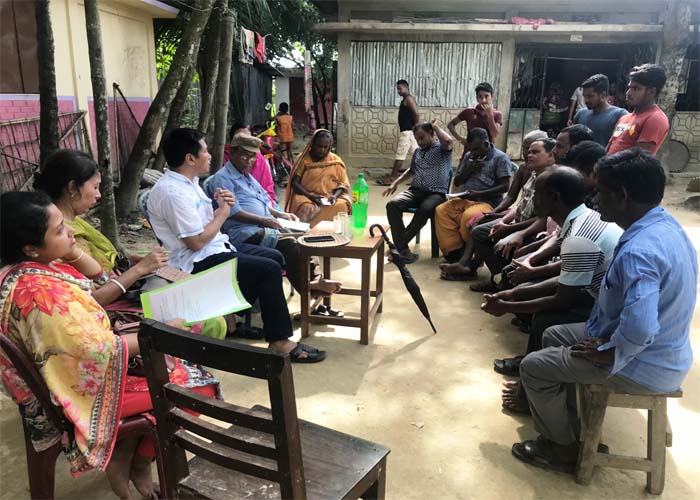
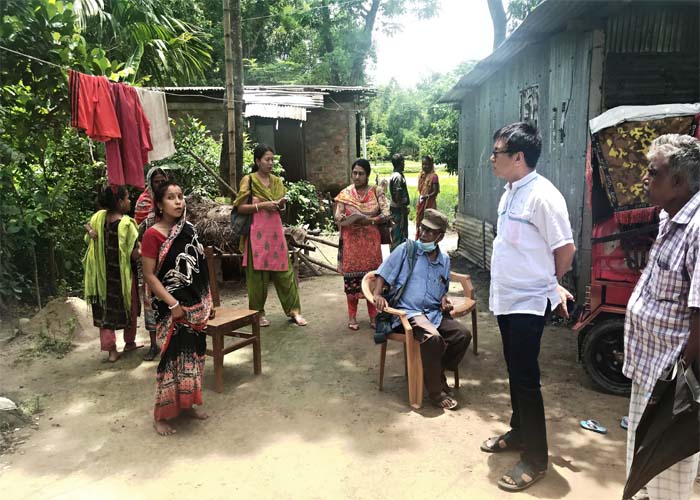
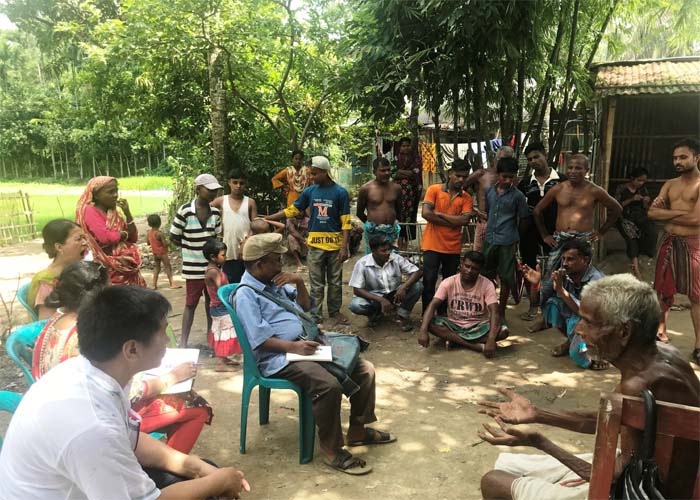
On 23rd July, 2022, ECDO team arranged a focus group discussion with the Shabdakar community living at Kamalganj upazila, Moulvibazar district. The main purpose of this FGD was to know more deeply about their living conditions and socio-economic status. FGD took place at the courtyard of a house at Moidal village. People from different sex, age and profession were attended on that meeting. Moreover, members from Shabdakar Social Development Council (Shabdakar Shomaj Unnoyon Porishod) were also present at the FGD. Some details about shabdakar communities are given below:
- Shabdakar communities can be found in different parts of India such as Kailashahar, Kamalpur, Agartala, Shillong, Hailakandi, Silchor, Bihar and Karnak.
- Shabdakar community claim themselves as indigenous people as they are the ancient population of the greater Indian subcontinent. Some of their characteristics indicate they belong to indigenous communities though they are not enlisted in our country’s indigenous population’s list.
- They never migrated from any other country or place. They have been living in this area since the very past. This is the proof of their ethnicity and original settlement in this country.
- They are known as untouchable and unholy to other majority communities.
- They face discrimination at all levels and are deprived of constitutional guaranteed basic needs such as food, clothing, shelter, education and medical care (Article-15).
- They were previously known as Dhuli, as they played musical instruments (such as Bengali traditional musical instrument Dhool) at weddings and different social programs. Gradually, their identity has been changed from Dhuli to Dhukla, baddyokor to Shabdakar. The Bengali meaning of the term Shabdakar is who creates noise/ sound (Shabda).
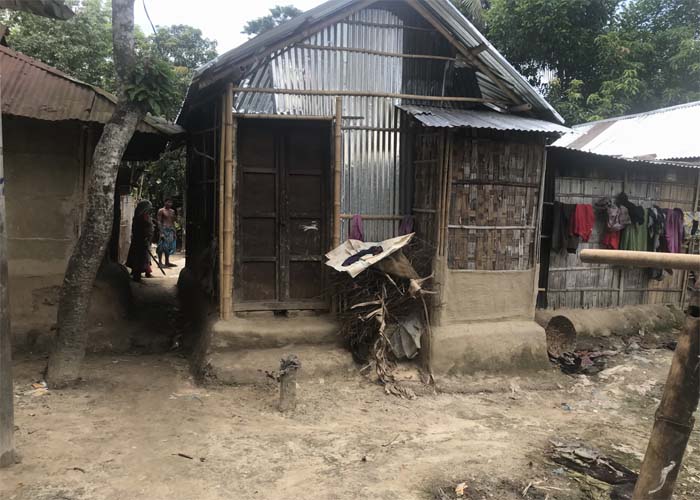
- Most of them are landless and live in houses built with straw and mud. They are not allowed to rent or build houses outside their designated localities. Over time, their population has increased and now more than four to five families have to share small areas of land and a large number of people are living under a single roof. We have seen through our observation that most of the shabdakar households have been using very unhygienic and unimproved sanitation facilities and they have no improved system of household wastes disposal. This causes different contaminated diseases to the children of that community.
- The occupation of shabdakar community has been changed gradually from farmer to labor. Most of the people of shabdakar community are involved in agriculture; they work in other’s land or home as day labor. Even some of them are now involved in pulling rickshaw and earn too little to manage the expenses of their family. Besides, the people of shabdakar community are engaged in many informal income generating activities such as working in restaurant or saloon.
- They are mostly illiterate as they can’t send their children to school due to their poverty. The children who go to school face discrimination due to caste system, the children from majority community don’t want to sit beside them; even the school authorities also behave with them badly and neglect them. Approximately most of the aged old people of this community have no literacy knowledge, even they can’t write their name. At present their literacy rate has slightly increased than before, but it wouldn’t be more than 20%. Somehow they can manage the cost of the primary education of their children by getting stipend from the government, but at secondary and higher secondary level, drop out tendency among school going children is higher. They want to send their children to school, but due to poverty, they can’t manage the expenses of their education. So there was a significant number of primary school completed children who couldn’t enrolled in secondary school. Although they have awareness regarding education and better lifestyle, due to caste discrimination they are not able to create a place for them in our society.
- They are facing inequality in access to work and employment. As they belong to low caste, they are not allowed to work in any middle or high ranked employment. So, as an excluded community, they have to work in some of the most menial and low paid jobs. Even in most cases, a large number of populations remained unemployed even after completing their education.
At present, many people of shabdakar community are changing their family name from shabdakar to only Kar, Chandra, Dev or Devi. They are changing their identity only for getting respect from mainstream community and privileges from society. It poses a great threat upon their identity as ethnic community and their existence in this region. Even some of them are shifting to other place with new identity so that their children can get that dignity and respect of which they were deprived of. In order to improve the lives of shabdakar community, there is an urgent need for changes in the mindset and behaviors of other majority community. Government and nongovernment organizations should come forward to educate and empower them so that they can raise their voices against all sorts of discrimination.