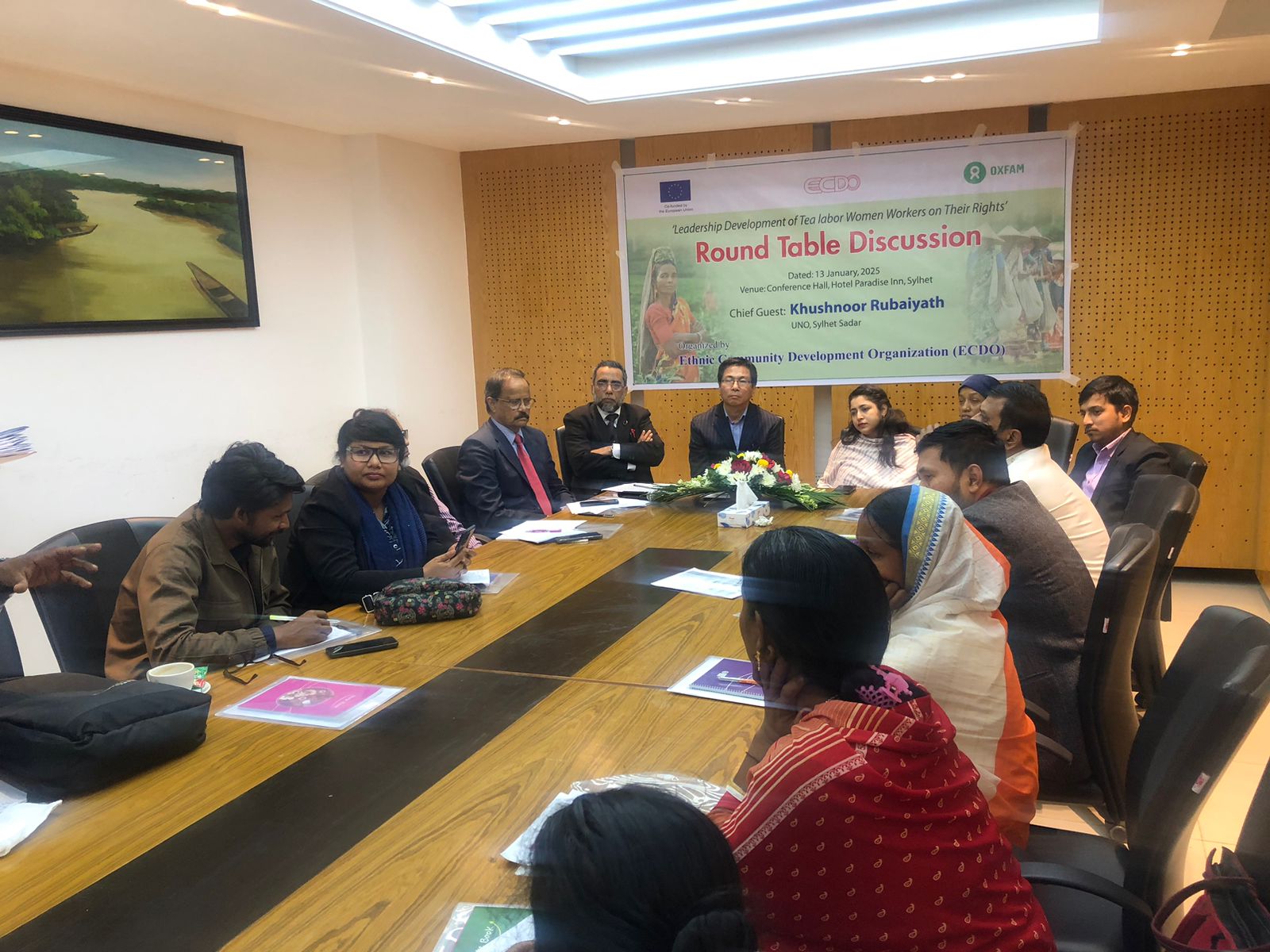
Round Table Discussion on Contemporary Issues of Tea Labor Community by ECDO

A round table discussion was held on Monday, January 13, 2025, in the hall room of a prestigious hotel in Sylhet City. The meeting, titled “Leadership Development of Tea-Garden Women Workers on Their Rights,” was organized by Ethnic Community Development Organization (ECDO) in collaboration with Oxfam in Bangladesh and European Union (EU). Advocate Emad Ullah Shahidul Islam, former president of Sylhet District Lawyers Association, moderate the whole program. The event began with a welcome speech by Mr.Lakshmikanta Singh, Executive Director of ECDO. Ms Khushnoor Rubaiyath, Upazila Nirbahi Officer (UNO) of Sadar Upazila, Sylhet, graced the occasion as the chief guest. Other distinguished attendees included Ms.Shahina Akhtar, Deputy Director of Women’s Affairs Department, Sylhet, Md. Farooqui Siam, Co-Manager of Lakkatura Tea Garden; and Ikramul Kabir, President of Sylhet Press Club. Local tea-labor community leaders, journalists, NGO representatives, Human Rights activists, and representatives of other civil society members also actively participated in the discussion session. Mr.Lakshmikanta Singh highlighted ECDO’s initiatives to raise awareness among tea workers about their rights, In his opening remarks. He explained how activities such as spot dramas, courtyard sessions, and training programs empower workers to understand their legal and human rights. Momtahinur Rahman Chowdhury, Project Coordinator of ECDO, presented the main paper outlining the critical challenges faced by tea workers. During his presentation, he shared alarming statistics from research conducted in December 2024 across three tea gardens— Doldoli, Kewachera, and Hiluachera. The findings revealed:
  • 74% of tea workers live below the poverty line.
  • 82% lack access to clean water.
  • Only 33% complete primary school.
  • Only 3% completed secondary school certificate.
  • Healthcare facilities are almost non-existent in the gardens.
  • Childcare facilities are not available in the tea gardens.
  • Workplace safety is not satisfactory.
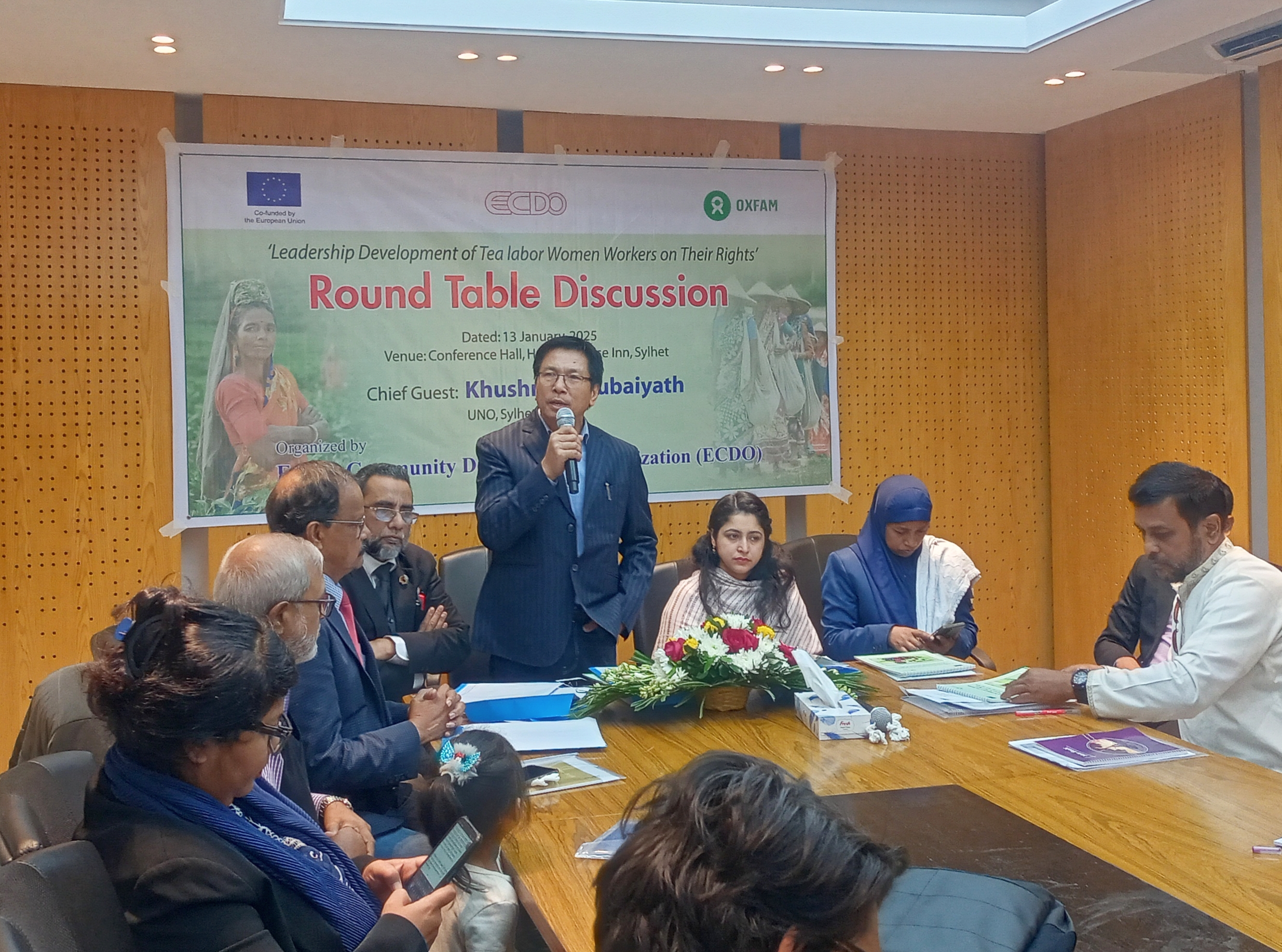
Abul Kashem Chowdhury, a member of Tuker Bazar Union Parishad, pointed out the lack of government primary schools in tea garden areas of Sylhet. He highlighted the challenges children of the tea labor Community face in accessing education and called for government support to improve educational and healthcare facilities in tea garden areas. Sumi Nayek, a female tea worker, shared her struggles of low daily wage of 178 taka, which is insufficient for proper food or to support her children’s education. She also highlighted the inadequate ration distribution and overcrowded living conditions, with families of 6-7 members often sharing a single house. Mintu Das, Tea Garden Panchayat President, pointed out that although there are 327 workers in his garden, the voter count stands at 1,200, reflecting significant unemployment. He also emphasized the poor housing and sanitation conditions. Sree Debu Bauri, President of the Sylhet Valley Executive Council, emphasized the dire living conditions of the tea labor community and their lack of land rights. He also raised concerns about the increasing prevalence of drugs in the tea garden areas. Md. Azim Uddin, Coordinator of FIBD, discussed various NGO initiatives in Sylhet’s tea gardens and stressed the importance of focusing on health, sanitation, and education in the future. Ikramul Kabir, President of the Sylhet Press Club, criticized the exploitation of the tea labor community, detailing how they are deprived of basic rights in education, healthcare, and in workplace. Md. Farooqui Siam, Co-Manager of Lakkatura Tea Garden, acknowledged the limitations in addressing the workers’ problems. He proposed bringing tea gardens under agricultural initiatives and called for breaking the syndicates that dominate the tea industry. Shahina Akhtar, Deputy Director of the Women’s Affairs Department, discussed the challenges at the grassroots level. She emphasized that only high-level government decisions could resolve the long-standing issues faced by the tea labor community. She stressed the importance of joint efforts from all stakeholders to address these challenges effectively. Ms. Khushnoor Rubaiyath, acknowledged the deep-rooted problems in tea gardens and emphasized the need for gradual, sustainable solutions. She stressed the importance of safe motherhood. She assured attendees of her support in improving education access for the tea labor community’s children and pledged to bring their concerns to higher authorities. She also encouraged tea workers to raise their demands collectively. The event concluded with a closing speech by Lakshmikanta Singh, who reaffirmed ECDO’s commitment to advocating for tea labor community rights and ensuring tangible improvements in their lives.

Leave a Reply

Your email address will not be published. Required fields are marked *